

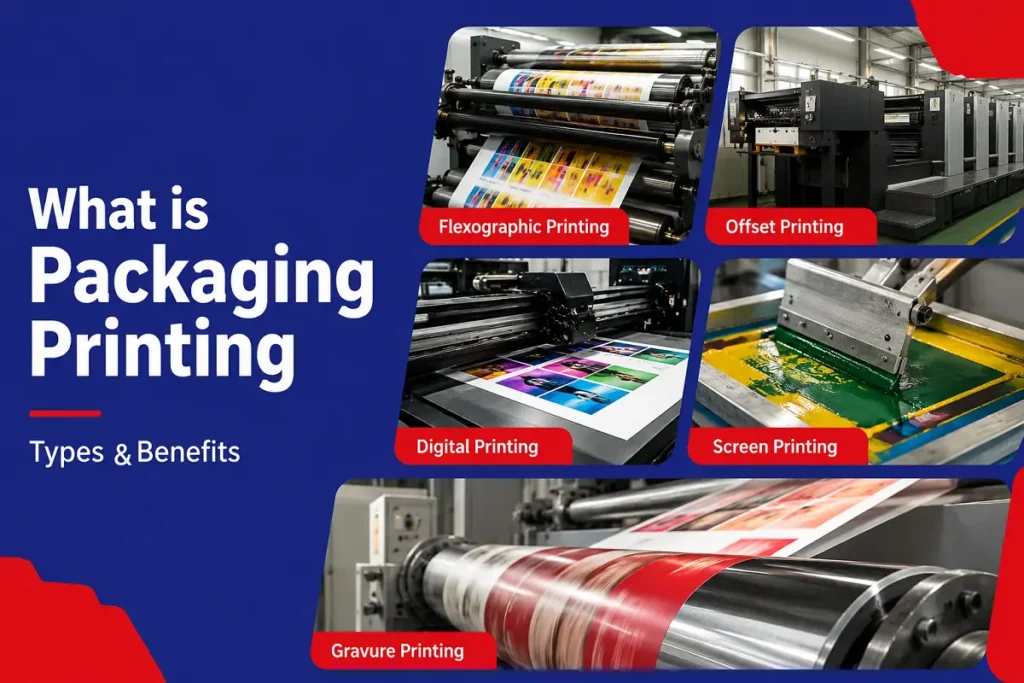
Globalization has boosted competition all over the business world. All successful businesses are in search of developing methods to distinguish their product in this race to gain a healthy share of the market and beat competitors. Printing on product packaging is a useful tool for grabbing customers’ attention.
Packaging Printing is a process that uses ink on materials like paper, cardboard, plastics, and corrugated boards in an attractive fashion that not only gives protection to the product, but also becomes a trademark of the business.
Why is Printing Required on Custom Boxes?
The owner of Rolls-Royce Limited, Sir Henry Royce, once said, “Quality is remembered long after the price is forgotten”. Printing of the package is the strongest non-verbal signal and a message of your quality products. It has the power to grab the attention of customers and ultimately influence the decision-making of product purchasing.
What Are the Different Types of Printing?
There are many types of printing used in the market, but we will discuss the main 5 types that are mostly used:
- Flexographic Printing
- Offset Printing
- Digital Printing
- Screen Printing
- Gravure Printing
We will discuss each type deeply along with pros and cons to get the best results for your products.
1. What is Flexographic Printing?
Flexographic printing is one of the high-speed, rotary relief printing technique that use flexible rubber plates. This type of packaging printing will suit you if you are looking for food wrappers, labels, and corrugated boxes, because it prints almost any material at a very high speed in bulk quantities. Flexographic printing is considered the standard for commercial packaging in the industry.
What Are the Advantages of Flexography?
High Versatility:
1. It can be used on both kinds of absorbent and non-absorbent surfaces such as paper, plastic, metallic foils, cardboards, and corrugated board, etc.
2. This method can help you in fulfilling diverse packaging needs
Bulk Production Capability:
1. Flexographic printing can produce results at very high speeds in a short time
2. This method can be ideal for large quantity packaging production
Multi-color Options:
1. This printing method allows you to achieve colorful output in up to 10 colors.
2. This technique proves to be excellent for retail packaging, labels and pouches
• Eco-Friendly and Cost-effective:
1. This method provides cost-effective results, as the production is in bulk. Moreover, it is compatible with UV and water-based inks.
2. It emits fewer harmful wastes as compared to some other traditional setups.
What are the Disadvantages of Flexography?
• High initial setup costs:
Printing plates and setup installation can be expensive.
• Color Matching Challenge:
Precise color matching can sometimes become difficult to achieve.
• Longer Setup Time:
Adjusting the press and preparing plates takes time for short-run jobs.
• Not ideal for precision-required jobs:
Tiny writing and fine artwork cannot be achieved accurately on this setup; to meet precision and fine details, you can choose the offset printing method.
2. What is Offset Printing (Lithography)?
Offset printing is a method to get high-quality prints in bulk quantities without compromising the quality. This type of printing suits the printing of packaging, books, magazines, newspapers, and brochures.
Advantages of Offset printing:
Offset printing proves itself a preferred choice in printing many jobs due to certain benefits:
Quality Results:
Offset printing serves as a first choice where accuracy and preciseness in required. It creates sharp images, vibrant colors, and fine textures that give accuracy and attraction to packaging materials.
Cost-effectiveness:
It proves to be a cost-effective option when printing on a large scale, as the fixed cost is divided equally among each unit.
Color consistency:
It ensures uniform color distribution and standardized color reproduction necessary for a brand’s trademark.
Endurance of colors:
The inks used in this method are high-quality and not prone to wear or fading, making them a first choice for printing books and custom packaging materials.
Precision:
This technique enables the user to reproduce the artwork without compromising the standards.
Disadvantages of Offset printing:
Although offset printing is a useful technique in business packaging, it still has some limitations and disadvantages:
Material wastage:
While calibrating and setting up the machine, some ink and paper get wasted.
Installation of setup is Costly:
As the setup of plates and the machine takes time and money, this setup doesn’t prove to be economical for small printing jobs.
Requirements of skilled staff:
As the machine operation is complex, a skilled technician and operator for the operation are vital.
Versatility issue:
Getting the diverse outputs on a small scale can be an expensive task in an offset printing setup.
3. What is Digital Printing?
Digital printing, as its name implies, is the method of printing in which traditional plates used in flexographic and offset printing are bypassed. An inkjet printer or laser jet printer, which is attached to a computer, gets the commands in digital form and prints exactly what is commanded.
Advantages of Digital Printing:
Digital printing serves a lot of purposes; we will shed light on a few of the benefits:
Cost-effective for small businesses:
Digital printing fulfills the need for printing for small businesses. Traditional printing setups are expensive, although their printing is cheaper, but they are not suitable for small jobs. So, digital printing serves this purpose and proves to be the cost-effective option.
Time-saving method:
As there is only a prompt required from the computer, unlike other methods, there is nothing to do with changing plates, so time and money both can be saved.
Direct Curing of the printed item:
One of the major advantages of direct curing is that printed items are instantly ready for handling and use, as the ink cures almost immediately after printing.
Disadvantages of Digital printing:
Bulk Cost:
Digital printing cannot be a wise decision when you have to print in bulk quantities. Flexography and offset printing are considered the best options in this regard.
Color accuracy challenge:
Printers use CMYK ink drops to create the colorful prints. This method works well mostly, but can produce results not up to the standard while printing pastel colors. The output of these colors could be uneven droplets of paint on paper and unexpected results.
4. What is Screen Printing?
Screen Printing is a method of printing in which a mesh and stencil (a die with small holes to pass the paint down for printing) are used to paste the exact intended thing on the paper, clothes, and custom packaging in mass quantities. This method is valued for providing vibrant colors, durability, and printing on multiple items.
Advantages of Screen Printing:
Screen printing provides multiple advantages; we will discuss a few of them here:
Durability of Colors:
Screen printing is one of the best sources for providing almost permanent colors on printed products, because the ink used here is quite heavy and resists fading, scratching, and wear.
Source of vibrant colors:
Screen printing provides bright, rich, and highly visible colors. These colors remain vivid on dark materials.
Usefulness for multiple materials:
This printing technique works on several surfaces, such as:
• Paper
• Plastic
• Glass
• Metals
• Wood
• Cupboard
Cost-Effective for Mass Printing:
This technique of printing is very economical because the mesh and stencil prepared once can be used multiple times. The setup, if used properly, can deliver reliable and high-quality output.
Disadvantages of Screen Printing:
Although screen printing serves vibrant colors and durability, it still has certain limitations, such as wastage of ink and material, along with incompatibility while dealing with changing names, QR codes, and uniqueness in each product. Other limitations are mentioned below:
Slower production for multiple color printing:
Printing becomes time-taking when there are multiple colors to print on material, as each color needs a screen and time that can slow down the rhythm and production.
Requirement of Storage space:
Businesses who deals with this type of printing need proper space to store their printing screens for future orders that costs the business.
Limitation for color usage:
As each color needs separate input for printing on the material, it not only takes time, but also limits the usage of color and poses a challenge while printing detailed images, gradients and photographic designs.
5- What is Gravure Printing?
Gravure Printing is one of the famous types of printing that has a major share in the printing of food packaging wrappers and gift wrappers. It is also used in the printing of magazines and other packaging items. Rollers are used in this technique, and this technique is considered the top choice when you have to print on uneven and cylindrical surfaces.
Advantages of Gravure Printing:
This printing technique serves multiple advantages that give it an edge over other techniques. A few of the benefits are written below:
High speed production:
This technique is famous for high-volume production at high speeds without compromising the standards. Some modern press machines can produce around 14 Meters of print per second.
Low Labor cost:
As the production is almost automatic, it results in low labor costs. This technique can save a lot when printing in bulk quantities.
Urgently Drying Inks:
The ink used in this technique dries quickly compared to other techniques, which helps in speeding up the printing operation.
Durable Printing Cylinders:
The setup used in this technique proves to be durable and reliable if maintained properly.
Disadvantages of Gravure Printing:
Although Gravure printing serves multiple advantages, it still has some limitations.
High Start-up Cost:
Although this type is cost-effective, the initial setup for this type of pressing is quite high. This printing setup is durable and serves for millions of prints, but initially you will have to spend a lot for this setup.
Less competitive:
This printing technique is not a cost-effective choice if you want to print in small quantities. In small quantities, digital printing is remarkable and more cost-effective.
FAQs:
1. Can packaging printing be eco-friendly?
Yes, packaging is an eco-friendly tool for your business, as the emissions of any printing press are not hazardous to health. The inks are quite sustainable and paper can be recycled again. Advancements in ink manufacturing laid to production from the soy-based and vegetable-based inks that have replaced the use of petroleum-based inks. Digital printing has reduced ink and material wastage to zero percent.
2. How does packaging printing affect branding?
Quality printed packaging can help to achieve the following goals for any brand:
- It acts as a brand ambassador of your product
- It distinguishes the product’s shelf display
- Builds long-term customer retention
- It gives a feeling of unboxing to consumers
- Creates brand recognition
- Increases brand loyalty
- Attracts potential buyers through appealing designs
- Boosts brand’s sales
3. How does color accuracy in printing affect packaging?
Color accuracy directly impacts the packaging, as an attractive and consistent color can help to shape a brand’s identity. Successful packaging platforms like Global Custom Box take the services of consumer psychologists for the selection of colors that can attract certain genders and age groups. The use of the correct color and attractive packaging is not just a protection of your product; these are the advertising tools for your business as well.